MediaDari Insights/Lead Generation
10 Steps to Build a Sales Funnel | MediaDari
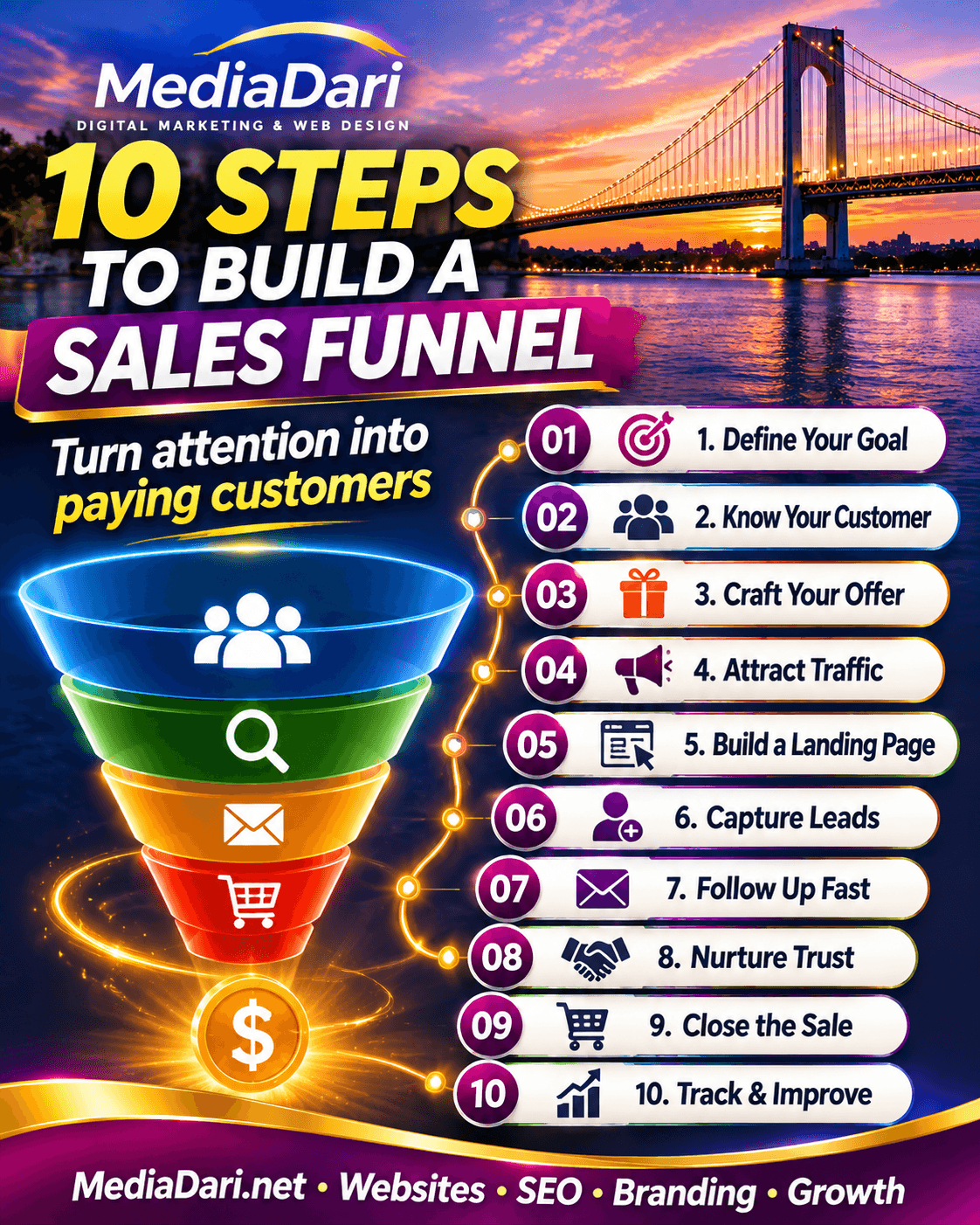
10 Steps to Build a Sales Funnel That Turns Website Visitors Into Paying Customers
Your website is getting visitors. Your Instagram posts are getting likes. Your advertisements are reaching people. But here's the question that matters most: Are those people becoming paying customers?
Every business owner wants more sales.
Whether you operate a Staten Island nail salon, a bakery, a contracting company, a healthcare practice, or an online service business, attracting attention is only the beginning.
You need a process that guides potential customers from discovering your business to choosing your services.
That process is called a sales funnel.
And when it's designed properly, it can become one of the most valuable parts of your marketing strategy.
At MediaDari, we believe your website, SEO, social media, branding, and lead management should work together toward one objective: helping your business grow.
Let's explore the 10 most important steps to creating a sales funnel that does more than attract clicks.
What Is a Sales Funnel?
A sales funnel represents the journey someone takes from first discovering your business to becoming a customer.
Think about the last time you purchased something.
You probably discovered a product or service, researched your options, compared prices, looked at reviews, and eventually made a decision.
Your potential customers follow a similar process.
A typical sales funnel includes four broad stages:
Awareness: Someone discovers your business through Google, social media, advertisements, or a recommendation.
Consideration: They visit your website, explore your services, and evaluate whether your business meets their needs.
Conversion: They make a purchase, request an estimate, book an appointment, or take another meaningful action.
Retention: You continue providing value and encourage satisfied customers to return or recommend your business.
A successful funnel connects these stages into a convenient customer experience.
Here are 10 practical steps for building one.
Step 1: Define Your Goal
Before you invest in a website, advertising, or content creation, determine what you want your marketing to accomplish.
Do you want more appointment bookings?
More phone calls?
More custom cake orders?
More requests for roofing estimates?
More consultations with potential clients?
A sales funnel needs one clearly defined primary objective.
For example, a Staten Island contractor might want to generate qualified requests for roofing estimates.
A nail salon might focus on booking appointments.
A digital marketing agency might want business owners to schedule discovery calls.
These businesses need different funnels because their customers take different actions.
Ask yourself:
- What action do I want visitors to take?
- How much is a new customer worth to my business?
- What qualifies someone as a serious lead?
- How will I measure success?
The clearer your objective, the easier it becomes to build a marketing strategy around it.
Step 2: Know Your Ideal Customer
One of the biggest marketing mistakes small businesses make is trying to appeal to everyone.
But not everyone is your ideal customer.
A Staten Island barbershop specializing in premium grooming services has a different audience from a family-focused neighborhood salon.
An independent psychiatric nurse practitioner has different marketing needs from a cake decorator.
Before building your funnel, understand your audience.
Identify:
- Who your ideal customer is
- What problem they're trying to solve
- Where they search for services
- What influences their purchasing decisions
- What concerns might prevent them from buying
- What information they need before making a decision
When you understand your customers, you can create marketing messages that speak directly to their needs.
That's much more effective than simply telling everyone to buy from you.
Step 3: Create an Offer People Actually Want
Your offer is the reason someone should choose your business.
It doesn't necessarily need to include a discount.
Sometimes the most compelling offer is convenience, professionalism, specialization, or a solution to a specific problem.
For example:
A contractor might offer a complimentary estimate.
A bakery might offer custom cake consultations.
A marketing agency might offer a website evaluation.
A beauty professional might promote convenient online appointment booking.
The important question is:
What value will customers receive when they take the next step?
Your offer should be clear, relevant, and easy to understand.
Avoid vague promises.
Instead of saying "We provide amazing services," explain the actual benefit.
For example:
"Get a professional website that makes it easier for customers to find your business, explore your services, and request an appointment."
That gives prospective clients something concrete to evaluate.
Step 4: Attract the Right Traffic
Now that you understand your audience and offer, it's time to bring potential customers into your funnel.
This is where digital marketing becomes important.
There are several ways to attract visitors.
Search Engine Optimization (SEO)
SEO helps your website become more discoverable for relevant searches.
For example, someone searching "web design Staten Island" may be looking to hire a professional.
A business that appears for the right search queries has an opportunity to introduce its services to people already researching a purchase.
Social Media Marketing
Instagram, Facebook, TikTok, and other platforms can help you introduce your brand, demonstrate your expertise, and connect with potential customers.
Google Business Profile
For eligible local businesses, a well-maintained Google Business Profile can help people discover business information on Google Search and Maps.
Paid Advertising
Google Ads and social media advertising can help businesses reach targeted audiences, depending on their objectives, budget, and industry.
Content Marketing
Informative articles, tutorials, educational posts, and videos can answer customer questions and introduce your business.
The goal isn't simply more visitors. It's attracting visitors who could realistically become customers.
Step 5: Build a Landing Page Designed to Convert
Here's where many businesses lose opportunities.
They invest money in advertising or spend hours creating content, but send visitors to a confusing website.
A landing page is a focused webpage designed to encourage one important action.
For example, an advertisement promoting custom websites could lead visitors to a page featuring:
- A headline explaining the service
- Examples of previous work
- Benefits of professional web design
- Customer testimonials
- Pricing guidance
- Frequently asked questions
- A clear consultation button
The page should answer the questions visitors are likely to have.
What makes a strong landing page?
Clear headlines: Explain what you offer immediately.
Compelling visuals: Use relevant photographs, examples, or graphics.
Simple navigation: Don't overwhelm visitors with unnecessary options.
Trust signals: Show genuine reviews, credentials, or examples of your work.
Mobile-friendly design: Make the experience convenient on smaller screens.
A strong call to action: Give visitors a clear next step.
Your landing page should support the offer that brought someone there.
At MediaDari, we approach custom website design for Staten Island businesses with a focus on branding, usability, and customer conversions.
Step 6: Capture Leads Before Visitors Disappear
Not everyone who visits your website is ready to purchase immediately.
Some are comparing options.
Others are researching pricing.
A few may be interested but need more time.
Without a way to capture appropriate contact information, many of those potential opportunities may disappear.
That's why lead capture is important.
Lead capture options include:
- Contact forms
- Free estimate requests
- Consultation scheduling
- Newsletter subscriptions
- Downloadable guides
- Custom-order inquiry forms
- Product demonstrations
The information you request should be relevant to the visitor's inquiry.
Don't make customers complete unnecessarily long forms.
For healthcare practices and other sensitive industries, use appropriate privacy safeguards and approved systems when collecting protected or sensitive information.
A lead capture system should make it easy for interested people to begin a conversation with your business.
Step 7: Follow Up While Interest Is High
Imagine someone requests a website consultation from your business.
They complete your contact form.
Then nothing happens.
No confirmation email.
No appointment link.
No acknowledgment.
By the time you respond, they may have contacted several competitors.
A sales funnel should help prevent this experience.
Consider automating:
Inquiry confirmations
Let prospects know their message was received.
Appointment scheduling
Provide convenient options for booking a consultation.
Internal notifications
Alert the appropriate team member when a new inquiry arrives.
CRM lead tracking
Keep contact information, inquiry details, notes, and follow-up tasks organized.
Follow-up messages
Send relevant, permission-based communications when additional information is needed.
Automation doesn't replace personal service.
It helps make sure that interested customers receive timely attention.
Step 8: Build Trust Before Asking for the Sale
Not every potential customer will purchase immediately.
Some need reassurance that your business is legitimate, experienced, and capable of delivering what they're looking for.
That's where trust-building content becomes valuable.
Consider what a potential customer might want to see before spending $1,500 on a website.
They might want examples of previous projects.
They might want to understand how the development process works.
They may need information about ongoing costs, ownership, SEO, or maintenance.
Trust-building content can include:
- Case studies
- Portfolio examples
- Genuine customer testimonials
- Educational blog articles
- Service comparisons
- Frequently asked questions
- Transparent pricing information
- Professional credentials and experience
Your website should answer concerns before they become reasons for visitors to leave.
For example, MediaDari can explain the differences between custom website development and DIY website builders to help business owners evaluate their options.
The more clearly you communicate what customers can expect, the easier it becomes for them to make informed decisions.
A strong sales funnel doesn't pressure every visitor to purchase immediately. It supports the decision-making process.
Step 9: Make It Easy to Close the Sale
You've attracted a potential customer.
They visited your website.
They explored your services.
They contacted your business.
They received a response.
Now comes the final step toward becoming a paying customer.
The purchasing process should be straightforward.
Depending on your business, this might include:
- A clearly written proposal
- Online scheduling
- A secure checkout page
- An electronic service agreement
- Deposit payment options
- A simple onboarding process
- Clear next steps after purchase
For example, a website development agency might present a proposal explaining deliverables, pricing, payment milestones, timelines, and maintenance options.
A bakery might provide an order summary, pickup information, and secure payment instructions.
A salon might offer a booking system with a clear cancellation policy.
Removing unnecessary friction can make it easier for interested customers to complete their purchase.
Step 10: Track Results and Improve Your Funnel
Your sales funnel shouldn't be something you create once and forget.
You need to understand what's working.
Imagine your website receives hundreds of visitors, but only a few people complete your contact form.
That may indicate a problem with the offer, audience targeting, page experience, or form.
Now imagine people frequently complete the form, but very few become paying customers.
The problem may be related to lead quality, pricing, follow-up, or how the service is presented.
Tracking helps you identify where improvements are needed.
Important metrics include:
Website traffic: How many people visit your website?
Traffic sources: Are visitors coming from Google, advertisements, social media, or referrals?
Lead conversion rate: What percentage of visitors become leads?
Lead-to-customer conversion rate: How many leads eventually make a purchase?
Cost per lead: How much are you spending to generate each inquiry?
Customer acquisition cost: How much does it cost to acquire a paying customer?
Revenue: How much actual business is your funnel generating?
Google Analytics can help track important website actions through key events, while your CRM or sales records can help connect inquiries to actual customers.
The purpose isn't simply to collect impressive numbers.
It's to identify the activities that contribute to real business outcomes.
An Example: How a Staten Island Bakery Could Use a Sales Funnel
Imagine a local bakery that specializes in custom birthday cakes.
Here's how a simple funnel might work.
First, create awareness.
The bakery posts a beautiful cake-decorating video on Instagram and publishes helpful content about custom birthday cakes in Staten Island.
Next, create interest.
Visitors click through to a dedicated custom cake page featuring photographs, serving sizes, starting prices, and ordering information.
Then, capture the inquiry.
A visitor completes a custom cake request form with the celebration date, number of guests, and design preferences.
Follow up.
The bakery receives the request, sends a confirmation, and contacts the customer to discuss the order.
Build trust.
The website showcases previous cake designs, real customer testimonials, and ordering policies.
Close the sale.
The customer approves the quote and pays the required deposit.
Measure the results.
The bakery tracks where inquiries originated and which marketing activities generated confirmed orders.
Notice something?
The website, Instagram, lead form, follow-up process, and payment system aren't separate strategies anymore.
They're connected parts of one customer journey.
That's the real power of a sales funnel.
Why a Beautiful Website Alone Isn't Enough
Your website can look absolutely incredible.
But if it doesn't explain what you offer, reach the right audience, or guide visitors toward meaningful actions, it may not generate the business results you expect.
Similarly, social media engagement doesn't automatically translate into sales.
And advertising campaigns don't guarantee revenue simply because they receive clicks.
Effective digital marketing is about connecting the pieces.
Your branding creates recognition.
Your SEO improves the opportunity for discovery.
Your content builds interest.
Your website communicates value.
Your lead capture system collects inquiries.
Your follow-up process maintains communication.
Your sales process helps customers take the next step.
Together, these elements create a more organized approach to business growth.
How MediaDari Can Help Build Your Sales Funnel
At MediaDari, we don't believe a website should exist simply because every business is expected to have one.
We believe your online presence should support your actual business objectives.
That's why we provide services that can work together as part of a broader digital marketing strategy.
Our services include:
Custom Website Design & Development
Professional websites designed around branding, customer experience, and clear calls to action.
Search Engine Optimization
Improving website structure and content to support relevant search visibility.
Google Business Profile Management
Helping eligible local businesses maintain accurate information and a stronger local presence.
Social Media Content Creation & Management
Creating consistent content that introduces your brand and supports customer engagement.
Website Copywriting
Helping communicate your services, value proposition, and customer benefits more clearly.
Lead Generation & Marketing Strategy
Developing customer journeys that connect marketing channels with opportunities for inquiries and sales.
Paid Advertising
Creating and managing Google and social media advertising campaigns aligned with business objectives.
Website Maintenance & Ongoing Improvements
Keeping your website current and improving the customer experience as your business evolves.
Whether you're a Staten Island contractor, healthcare professional, beauty entrepreneur, bakery owner, or another small-business operator, your marketing strategy should reflect the way your customers actually find and choose services.
Final Thoughts: Stop Collecting Clicks. Start Building a Customer Journey.
A successful sales funnel isn't about manipulating people into buying.
It's about making the process of discovering, evaluating, and choosing your business easier.
You don't necessarily need complicated technology or an enormous advertising budget to begin.
Start by understanding your customers.
Create a compelling offer.
Build a professional online experience.
Make inquiries easy.
Follow up consistently.
Measure your results.
And continue improving.
Your website shouldn't simply attract attention. It should help turn that attention into meaningful business opportunities.
Ready to Build a Website That Works Toward Your Business Goals?
MediaDari helps local businesses connect web design, SEO, branding, and digital marketing into a more coordinated online presence.
Explore our Staten Island Web Design Services or visit www.mediadari.net.
MediaDari — Websites. Branding. Marketing. Growth.
Marketing outcomes vary by industry, competition, budget, and execution. No sales funnel guarantees a specific number of leads or customers.
Ready to strengthen your online presence?
MediaDari helps businesses with web design, development, digital marketing, branding, and AI automation.
Let's Talk