MediaDari Insights
Custom Website vs. Website Builder: Which Is Better for Your Business?
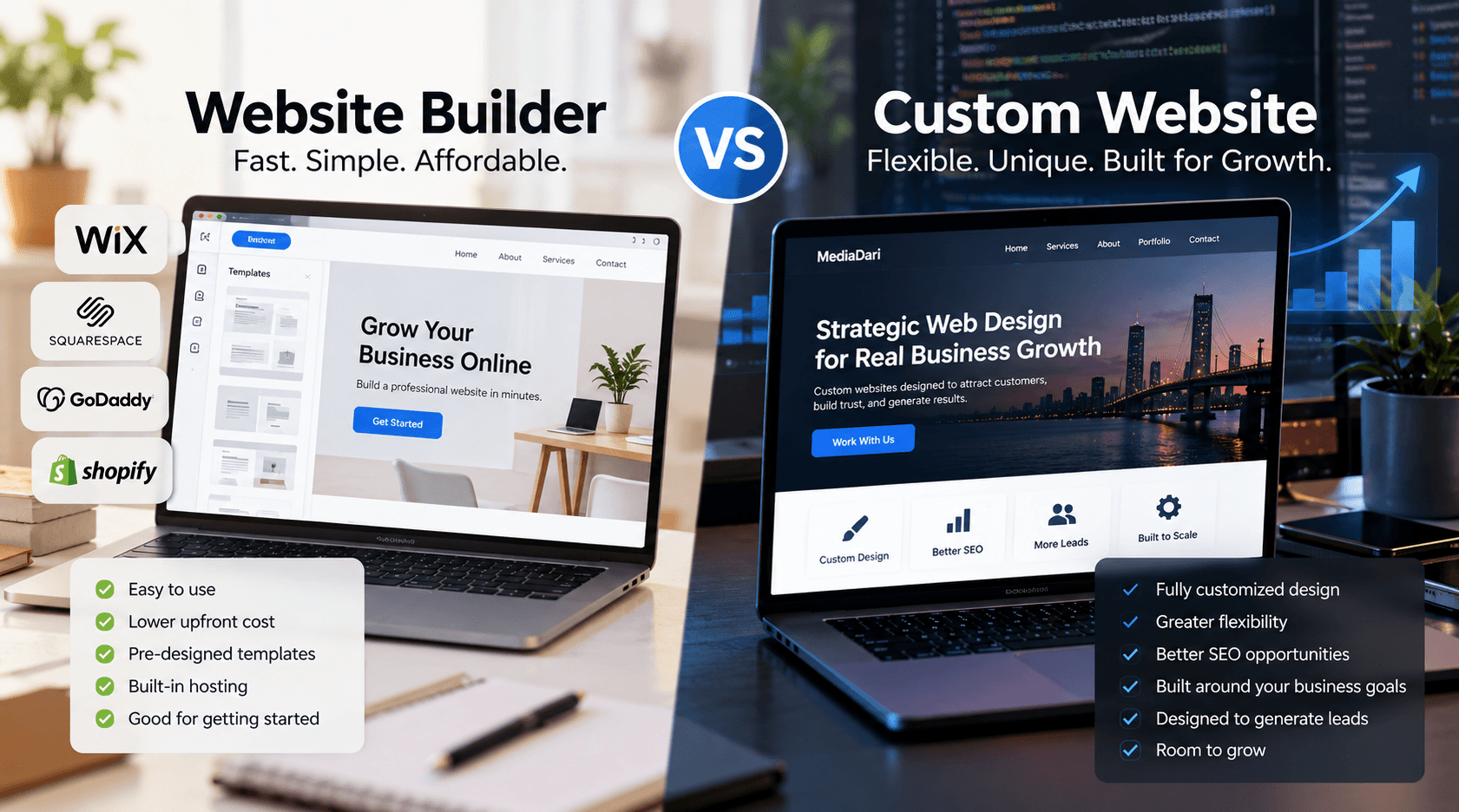
Your website is often the first impression a potential customer has of your business. Before someone calls, books an appointment, or requests a quote, there's a good chance they've already looked you up online.
But here's a question many business owners eventually face:
Should you build your website using a platform like Wix, Squarespace, or GoDaddy, or invest in a professionally developed custom website?
At first glance, website builders seem like an obvious choice. They're affordable, relatively easy to use, and promise professional results without requiring technical experience.
And for some businesses, they're perfectly adequate.
However, there's an important difference between having a website and having a website strategically built to help your business grow.
Let's explore the advantages, limitations, and long-term value of both options.
What Is a Website Builder?
Website builders are platforms that allow individuals and businesses to create websites using predesigned templates, visual editors, and built-in tools.
Popular examples include Wix, Squarespace, GoDaddy Website Builder, and Shopify.
These platforms have made it easier than ever to establish an online presence.
For a new business with a limited budget, a website builder can be a practical starting point.
Many platforms include hosting, mobile-friendly templates, contact forms, basic analytics, and SEO settings.
So what's the downside?
The challenge isn't necessarily what a website builder can do today. It's whether the platform can support everything your business needs tomorrow.
As your company grows, you may eventually need more specialized features, integrations, design flexibility, or control over how your website functions.
That's where custom website development becomes worth considering.
What Is a Custom Website?
A custom website is designed and developed around your business's specific goals rather than relying primarily on a prebuilt template.
Instead of forcing your company into an existing design structure, developers can create a website that reflects your brand, customer journey, and operational needs.
For example, a custom website could include an advanced appointment booking system, interactive service calculators, specialized customer portals, or automated lead collection workflows.
Modern development technologies such as Next.js and React give developers considerable flexibility to create these experiences.
But the biggest advantage of custom development isn't simply the technology.
It's the ability to make business decisions drive the design, instead of allowing the limitations of a template to determine how the business operates online.
1. Your Business Deserves More Than a Generic Template
Imagine visiting five competing businesses and discovering that their websites look nearly identical.
The layouts are similar. The navigation feels familiar. Even the calls to action are positioned in the same places.
While templates can look attractive, relying heavily on common designs may make it harder to establish a distinctive brand identity.
A custom website creates an opportunity to develop a visual experience around your company's personality and audience.
From typography and color combinations to animations, imagery, and page layouts, each element can be created with your brand in mind.
This matters because customers don't simply evaluate products or services.
They also evaluate trust, professionalism, and credibility.
A thoughtfully designed website can communicate those qualities before a potential customer ever speaks with you.
The benefit: A more distinctive online presence that helps customers recognize and remember your business.
2. Better Control Over Website Speed and Performance
Have you ever clicked on a website only to leave because the page took too long to load?
Your potential customers do the same thing.
Website performance affects how quickly visitors can access information, navigate between pages, and complete important actions.
Website builders vary considerably in performance. Some produce fast, well-optimized websites, while others may become slower depending on templates, applications, and added features.
Custom development offers greater control over how pages are built and delivered.
Developers can optimize images, reduce unnecessary code, choose appropriate hosting, and tailor the loading experience around the site's needs.
Of course, a custom website isn't automatically faster. It still needs to be engineered and maintained properly.
But with thoughtful development, businesses have greater flexibility to optimize performance as their requirements evolve.
The benefit: More control over loading speed and user experience, helping reduce unnecessary friction for potential customers.
3. Greater Flexibility for Search Engine Optimization (SEO)
One of the biggest misconceptions about web development is that custom websites automatically rank higher on Google.
That's not true.
Modern website builders can support important SEO features, including custom page titles, meta descriptions, sitemaps, redirects, and structured data.
Google doesn't automatically reward a website simply because it was custom coded.
What matters is whether the website provides relevant content, a useful experience, and a technical structure search engines can understand.
So where does custom development help?
It can provide additional flexibility when implementing advanced SEO strategies.
For example, a company serving multiple neighborhoods may want individually developed service pages for each location.
A business with dozens of services may need a sophisticated content structure that connects related topics and makes information easier to discover.
With a custom website, developers can tailor URL structures, internal linking, structured data, page templates, and content publishing systems around those needs.
Rather than working exclusively within a platform's existing framework, businesses can build an SEO strategy into the architecture of the website.
The benefit: Greater flexibility to support an expanding SEO strategy, especially for businesses targeting multiple services or geographic markets.
4. Your Website Should Generate Business, Not Just Look Attractive
Here's something many business owners overlook:
A beautiful website that doesn't help generate customers may not be accomplishing its most important business objective.
A restaurant might need online reservations.
A contractor might need estimate requests.
A mental health practice might need appointment scheduling and new-patient inquiries.
An attorney might need consultation requests.
Each business has different customers, services, and sales processes.
A custom website can be designed around those specific needs.
Instead of adding a generic contact form and hoping visitors use it, a developer can plan the entire customer journey.
Where should the visitor go after landing on the homepage?
What information will build confidence?
When should the website present a booking option?
How many steps should it take to request a quote?
These questions are about conversion optimization: turning website visitors into potential customers.
Custom development allows the business to build and improve that experience over time.
The benefit: A website designed around measurable actions such as calls, inquiries, appointments, and sales.
5. Custom Features and Business Automation
Your website can do much more than advertise your services.
It can also become an important part of your day-to-day operations.
Imagine a service business that receives dozens of inquiries every week.
Instead of manually collecting customer information and responding to every initial question, its website could include automated inquiry forms, appointment scheduling, and integrations with customer management tools.
Other possibilities include customer dashboards, quote estimators, payment integrations, secure portals, and customized administrative systems.
Some website builders offer these capabilities through built-in features or third-party applications.
However, businesses with specialized workflows may eventually encounter limitations.
Custom development gives companies the opportunity to create functionality around their existing processes—or redesign those processes to operate more efficiently.
The benefit: Less repetitive administrative work, smoother customer experiences, and technology that better supports business operations.
6. More Freedom as Your Business Expands
A website that works for a small business today may not meet its needs three years from now.
Perhaps you're opening additional locations, launching new services, introducing online payments, or expanding into a larger market.
With a website builder, expansion is influenced by the capabilities, pricing, and technical restrictions of the platform.
With custom development, you can choose an architecture designed to accommodate your expected growth.
You may also have greater flexibility in selecting hosting providers, databases, integrations, and other services.
However, custom websites still have ongoing hosting, maintenance, security, and development requirements.
And portability depends on how the website is built and who controls its code and accounts.
That's why working with a transparent development partner is essential.
The benefit: Greater control over your website's technical direction and long-term development.
7. Understanding the Real Cost
One of the strongest advantages of website builders is affordability.
A business owner can often launch a basic website for a relatively small monthly subscription.
For a company that only needs a few informational pages, this may be a sensible choice.
Custom development generally requires a larger upfront investment.
But comparing these options based only on initial cost overlooks an important consideration:
What value does the website deliver to the business?
Suppose a contractor earns $2,000 in gross revenue from an average completed project.
If website improvements help the business acquire additional profitable customers, the financial return could outweigh the initial development expense.
The actual return depends on profit margins, traffic, conversion rates, competition, and operating costs. No website can guarantee additional sales.
Still, a business website should be evaluated as more than a monthly expense.
It should be measured against the opportunities it creates, the time it saves, and the customers it helps attract.
Custom Website vs. Website Builder: Which Should You Choose?
The answer depends on your business's current needs and future plans.
A website builder may be the right choice if:
- You're launching a new business with a very limited budget.
- You need a simple informational website.
- You prefer making frequent visual changes yourself.
- Your business doesn't require specialized features or integrations.
A custom website may be the better investment if:
- You want a more distinctive and personalized brand experience.
- You're competing for customers in a crowded local market.
- You need advanced booking, payment, or customer management features.
- You plan to expand your services or geographic reach.
- You want greater control over website functionality and technical SEO.
- You want your website designed around lead generation and business growth.
Neither choice is universally better.
The right website is the one that supports your business goals, fits your budget, and delivers a positive experience for customers.
Already Have a Website Builder? You Don't Necessarily Need to Start Over
If your current website is built on Wix, Squarespace, or GoDaddy and is performing well, there may be no immediate reason to replace it.
Start by evaluating the results.
Are customers finding you through Google?
Are visitors contacting your business?
Does your website accurately represent your brand?
Can customers easily find your services and take the next step?
If the answer is yes, your existing website may be doing its job.
But if your business has outgrown the platform, your online presence looks dated, or you're struggling to implement important features, it may be time to explore a custom solution.
The key is identifying what needs improvement before making an investment.
Build a Website That Works for Your Business With MediaDari
At MediaDari, we believe a business website should be more than a digital brochure.
It should help establish credibility, communicate your value, attract potential customers, and make it easier for people to do business with you.
Our approach to custom website development focuses on combining professional design with practical business objectives.
Whether you're a local contractor, healthcare provider, service professional, or growing company, we build websites around what matters to your business.
From custom layouts and responsive design to SEO-ready architecture, lead generation, and specialized functionality, our goal is to help turn your online presence into a valuable business asset.
Your competitors have websites. The question is whether yours gives customers a compelling reason to choose you.
Explore our custom website design services in Staten Island, or visit MediaDari to discuss your next website project.
MediaDari — Websites Built for Business Growth.
Ready to strengthen your online presence?
MediaDari helps businesses with web design, development, digital marketing, branding, and AI automation.
Let's Talk