MediaDari Insights
Why Is My Website Not Getting Visitors or Generating Sales? 10 Reasons and How to Fix Them
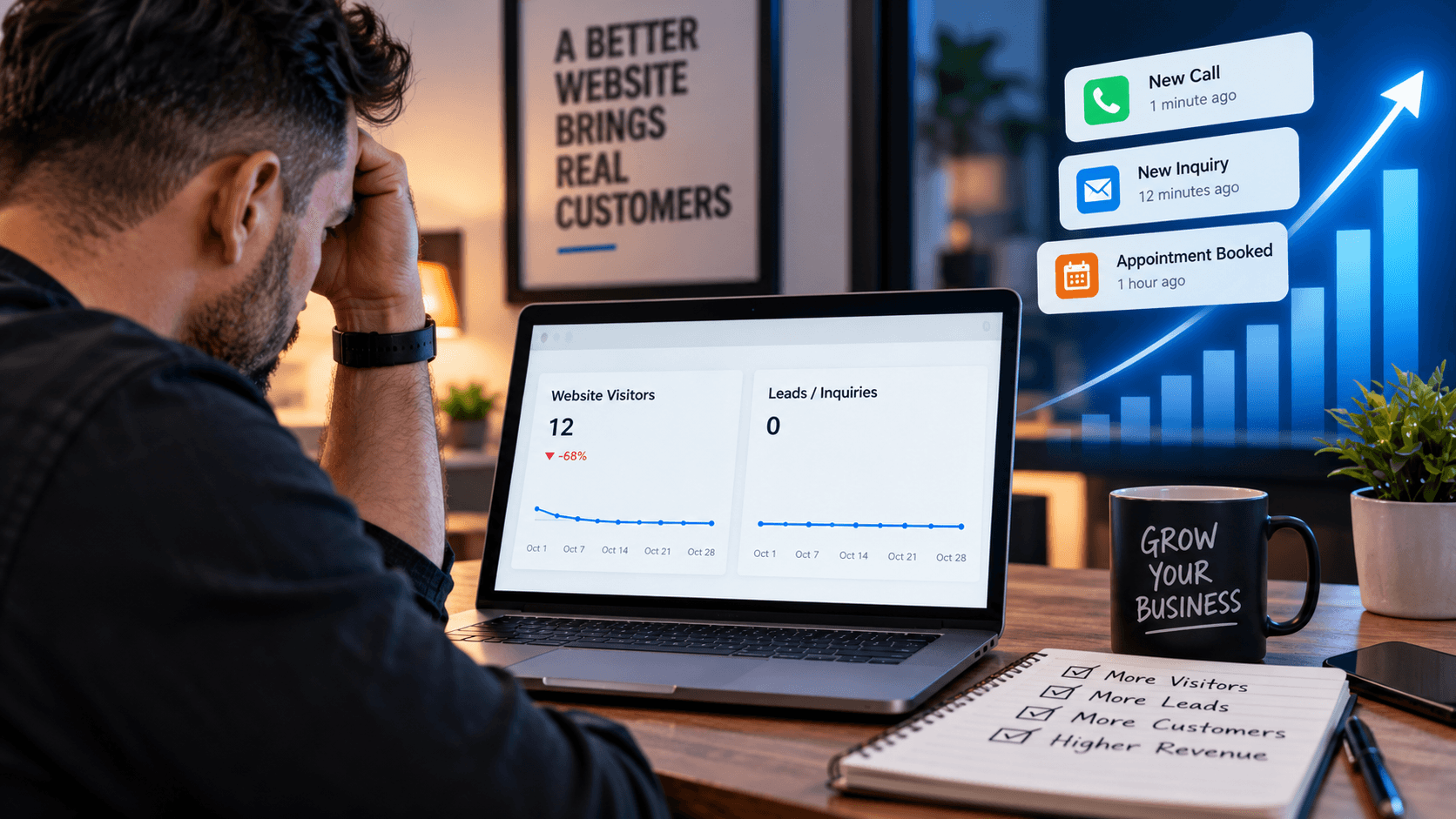
You spent money building a website for your business.
It looks professional. Your logo is prominently displayed. Your services are listed, and there's even a contact form.
But there's one major problem.
Nobody is visiting your website. And the few people who do aren't calling, booking appointments, or purchasing anything.
Sound familiar?
It's one of the most frustrating experiences for small business owners.
You invested in a website because you expected it to help grow your business. Instead, it sits online like a digital business card that nobody ever picks up.
Here's something important to understand:
Having a website and having a website that generates business are two very different things.
A website doesn't automatically attract customers simply because it exists.
To produce meaningful results, it needs visibility, relevant traffic, a compelling offer, and a clear path for visitors to become customers.
If your website isn't producing revenue, the problem usually falls into one of two categories:
- Traffic problem: Not enough potential customers are finding your website.
- Conversion problem: People are finding your website but aren't taking action.
Some businesses struggle with both.
Let's explore 10 common reasons your website isn't producing results and what you can do to change that.
1. Your Website Isn't Showing Up on Google
Imagine opening a beautiful storefront on a street nobody knows exists.
That's essentially what happens when you launch a website without considering search engine visibility.
Many business owners assume that once their website goes live, Google will automatically start sending them customers.
Unfortunately, that's not how search engines work.
Google needs to discover your website, understand what your pages are about, and determine when they're relevant to someone searching online.
A website can be technically accessible without appearing prominently in search results.
In some cases, pages aren't indexed at all.
How to fix it
Start by checking whether Google can find your website.
Use Google Search Console to review which pages are indexed, identify technical issues, and understand which searches generate impressions and clicks.
Next, make sure important pages have descriptive titles, useful content, and clear navigation.
If you operate a plumbing business in Staten Island, for example, your website should clearly explain that you offer plumbing services in Staten Island.
A vague homepage saying "Welcome to Our Company" doesn't communicate nearly as much to search engines or potential customers.
The goal isn't simply to appear on Google. It's to appear when the right customers are searching for what you offer.
2. You're Targeting the Wrong Keywords
Not all website traffic is equally valuable.
Let's say you're a roofing contractor.
You publish an article about the history of roofing materials, and it attracts hundreds of readers.
That's encouraging, but how many of those readers actually need a roof replacement?
Now imagine your website attracts someone searching for:
"Roof repair company near me"
"Emergency roof leak repair Staten Island"
"Roof replacement estimate Brooklyn"
Those searches can represent significantly stronger buying intent.
The difference is important.
A website with 100 relevant visitors can potentially produce more business than one with 1,000 visitors who have no intention of purchasing.
How to fix it
Focus your content on the questions and problems your ideal customers are actively searching for.
Create pages that explain your individual services, the areas you serve, the problems you solve, and how customers can work with you.
Educational articles can also attract potential customers earlier in their research process.
The strongest content strategy connects helpful information with clear opportunities to explore your services.
3. Your Website Looks Nice but Doesn't Encourage Action
Here's an uncomfortable truth about website design:
A beautiful website isn't necessarily a profitable website.
You can have stunning animations, professional photography, and an expensive logo.
But if visitors don't understand what you offer or how to contact you, those visual elements won't generate much business.
Think about the last time you visited a website looking for a service.
You probably wanted answers to a few simple questions:
- Does this company offer what I need?
- Can I trust them?
- Do they serve my area?
- How much might it cost?
- How do I get started?
If your website makes those answers difficult to find, visitors may leave and explore a competitor.
How to fix it
Make your website's purpose immediately clear.
Your homepage should communicate what you do, who you help, and what visitors should do next.
Add clear calls to action such as "Request a Free Estimate," "Schedule a Consultation," or "Call Now."
Place them where they naturally help users progress.
For businesses that depend on inquiries, make contact forms easy to complete and phone numbers easy to access on mobile devices.
Don't make potential customers work harder than necessary to contact you.
4. You're Ignoring Local Search Engine Optimization
If you operate a local business, this could be one of your biggest missed opportunities.
Think about how people find local services.
They search for phrases such as "barber shop near me," "electrician in Brooklyn," or "web designer Staten Island."
Google may display local business listings, maps, and organic website results.
If your business isn't well represented in those places, customers may discover competitors instead.
Having a website alone doesn't guarantee local visibility.
How to fix it
Make sure your Google Business Profile is accurate, eligible, and properly configured.
Include your real business information, relevant categories, services, and appropriate service areas.
Encourage genuine customer reviews without offering incentives in exchange for positive ratings.
On your website, explain where you operate and which services you provide in each relevant market.
For example, a contractor serving Staten Island and Brooklyn may benefit from genuinely useful location-specific content that answers questions unique to customers in those areas.
Avoid creating dozens of nearly identical pages that simply swap one city name for another.
Each page should serve a real purpose.
Local SEO helps connect your business with people who are actively searching for services in your market.
5. Your Website Is Too Slow or Difficult to Use on Mobile
A potential customer finds your website on Google.
They click your listing.
Then they wait.
The homepage loads slowly. Images take time to appear. The navigation is confusing, and the contact button is difficult to tap.
Instead of continuing, they leave.
Even if your company offers excellent services, a frustrating website experience can prevent visitors from becoming customers.
And because so many people browse websites using smartphones, the mobile experience is especially important.
How to fix it
Test your website on an actual phone.
Can visitors read everything comfortably?
Do buttons work properly?
Can someone call your business without searching through several pages?
Optimize large images, remove unnecessary scripts, and address obvious performance problems.
Tools such as Google PageSpeed Insights can help identify technical improvements.
Remember that speed isn't the only factor.
A fast website with confusing navigation can still lose customers.
The objective is to make doing business with your company as easy as possible.
6. Your Website Doesn't Build Enough Trust
Would you hire a contractor without knowing anything about their experience?
Would you book a healthcare appointment with a provider whose website offers no information about their qualifications?
Would you purchase an expensive service from a business with no clear contact information?
Probably not without doing more research.
Your customers feel the same way.
Trust is especially important when customers are making expensive, personal, or high-stakes decisions.
How to fix it
Show visitors why your business deserves their consideration.
Depending on your industry, this might include customer testimonials, authentic project photography, professional credentials, case studies, licensing information, or examples of completed work.
Make your contact information and business identity easy to verify.
Explain your process and what customers can expect.
Avoid exaggerated claims and fabricated reviews.
Real proof is far more valuable than generic statements about being the best company in town.
People are more likely to contact a business when they feel confident about who they're dealing with.
7. Your Website Isn't Answering Customers' Questions
Picture someone looking for a house cleaning service.
They visit your website and see a homepage, an About page, and a Contact page.
But they can't find anything explaining which cleaning services you provide, whether you offer recurring appointments, or which neighborhoods you cover.
What happens next?
They may leave to find a company that answers those questions more clearly.
Your website should help potential customers make informed decisions.
How to fix it
Create useful content around the questions customers ask before hiring you.
A cleaning company could publish articles explaining move-out cleaning, deep cleaning, and recurring service options.
A contractor could explain the difference between repairing and replacing a roof.
A website development company could explain the differences between custom websites and website builders.
This type of content accomplishes two things.
It helps visitors understand your services, and it creates additional opportunities to appear in relevant search results.
However, publishing articles alone doesn't guarantee search traffic.
Quality, usefulness, relevance, competition, and your overall search visibility all matter.
The purpose of content should be to help potential customers make decisions—not simply to fill your website with words.
8. You Aren't Actively Promoting Your Website
Here's something many new business owners don't realize:
Launching a website is often the beginning of your marketing effort, not the end.
Your website is the destination.
You still need ways for customers to find it.
Search engine optimization can help attract organic traffic over time, but depending on your competition, meaningful growth may require sustained effort.
And SEO doesn't need to be your only source of visitors.
How to fix it
Develop a marketing approach that connects multiple channels to your website.
For some businesses, that means regularly sharing helpful content through social media.
Others may benefit from Google Ads when customers are actively searching for their services.
Facebook and Instagram advertising may help reach local audiences, depending on the offer and targeting.
Email marketing, referrals, partnerships, and traditional advertising can also send relevant visitors to your website.
The key is understanding which channels produce actual customer inquiries rather than simply impressions or likes.
A roofing company and a clothing boutique probably shouldn't use identical marketing strategies.
Your marketing should reflect how your customers discover, research, and purchase your services.
9. You Don't Know What Visitors Are Doing
How many people visited your website last month?
Which pages did they view?
Where did they come from?
How many contacted you?
If you don't know the answers, you're essentially operating your website without a performance dashboard.
And without reliable information, it's difficult to identify what's working.
How to fix it
Use tools such as Google Analytics and Google Search Console to understand your website's performance.
Search Console can help you understand how people discover your business through Google Search.
Analytics can help you examine website visits and interactions.
Track meaningful actions, including completed contact forms, appointment bookings, phone-number clicks, and purchases where applicable.
Keep in mind that clicks on a phone number aren't the same as completed phone calls, and inquiries aren't the same as paying customers.
For service businesses, it's also valuable to track which leads become qualified prospects and actual customers.
When you understand that journey, you can make better decisions about website improvements and marketing spending.
10. You're Getting Leads but Not Turning Them Into Paying Customers
Sometimes the website isn't the only problem.
Imagine your site generates 15 inquiries in a month.
But several people never receive a response.
Others wait days for an estimate.
A few receive a generic message that doesn't answer their questions.
Eventually, they choose competitors.
In this situation, improving website traffic alone won't solve the underlying issue.
Your sales and follow-up process matters, too.
How to fix it
Make sure inquiries reach the right person.
Respond promptly during business hours.
Use organized customer management tools to keep track of leads and follow-up conversations.
Consider appointment reminders and appropriate automated responses that confirm an inquiry was received.
Most importantly, make it easy for customers to move from initial interest to the next step.
A website can open the door to a new customer, but your business still needs a process for turning that opportunity into a sale.
How Many Website Visitors Do You Actually Need to Make Money?
A common mistake is focusing exclusively on visitor counts.
Business owners sometimes assume that thousands of monthly website visits are required to generate meaningful revenue.
But visitor quality, conversion rates, and the value of each customer can matter just as much.
Consider this hypothetical example:
| Website metric | Example | |---|---:| | Monthly visitors | 500 | | Visitors who submit an inquiry | 2% | | Inquiries generated | 10 | | Inquiries becoming customers | 30% | | New customers | 3 | | Average revenue per customer | $1,500 | | Revenue from those customers | $4,500 |
These numbers are illustrative, not a prediction or industry benchmark. Actual results depend on your business, competition, lead quality, pricing, and sales process.
The example demonstrates an important principle:
It's not always about attracting the largest audience. It's about attracting the right people and giving them a reason to become customers.
For businesses with high-value services, a relatively small number of qualified inquiries may be meaningful.
That's why measuring results is more useful than chasing traffic numbers alone.
How to Tell What's Actually Wrong With Your Website
Before spending money on a redesign, advertising, or additional SEO, identify where the problem occurs.
If your website has very few impressions in Google Search:
Investigate indexing, keyword targeting, content relevance, competition, and technical SEO.
If your pages receive impressions but very few clicks:
Review the searches you're appearing for, your ranking positions, page titles, and how well your content matches what people want.
If visitors arrive but rarely contact you:
Evaluate your messaging, offer, trust signals, mobile experience, and calls to action.
If people contact you but rarely become customers:
Review lead quality, pricing, response times, your sales process, and follow-up.
Each situation requires a different solution.
You shouldn't automatically rebuild a website that primarily needs more visibility.
And you shouldn't pour advertising money into a website that makes it difficult for customers to get in touch.
A Simple 30-Day Plan to Improve Your Website's Results
If your website has been disappointing you, begin with a manageable improvement plan.
Week 1: Understand your current performance
Check your analytics, search visibility, indexing status, and existing inquiries.
Identify whether your primary problem is traffic, conversions, or lead follow-up.
Week 2: Improve the customer experience
Review your homepage and important service pages.
Clarify your offers, strengthen calls to action, fix broken contact forms, and improve the mobile experience.
Week 3: Improve your visibility
Review your local SEO, update important service content, and strengthen relevant internal links.
Publish helpful information addressing real customer questions where content gaps exist.
Week 4: Test and measure
Choose an appropriate marketing channel to test, review customer inquiries, and examine which changes produced useful results.
Thirty days may be enough to diagnose problems and implement improvements. It isn't a guarantee of meaningful ranking growth or additional sales.
The goal is to replace guesswork with a process you can continually improve.
Frequently Asked Questions
Why does my website have no visitors?
Your website may be new, poorly indexed, difficult to discover, targeting overly competitive keywords, or lacking an effective marketing strategy. Begin with Google Search Console to understand whether your pages are visible in search results.
Why am I getting website traffic but no sales?
Visitors may not be ready to purchase, your offer may be unclear, or your website may lack credibility and effective calls to action. Pricing, competition, and poor follow-up can also contribute.
Can a website generate customers without paid advertising?
Yes. Organic search, referrals, direct visits, and other unpaid channels can attract customers. However, acquiring consistent traffic typically requires ongoing marketing, useful content, and a competitive offering.
Should I redesign my website if it isn't making money?
Not necessarily. A redesign can be appropriate when your website has serious usability, branding, or technical limitations. But if your biggest problem is low visibility, improving your SEO or marketing may be more valuable than changing its appearance.
How long does it take for a website to generate leads?
There is no universal timeline. Results vary based on demand, competition, search visibility, marketing investment, and the website's ability to convert visitors. Some businesses receive inquiries quickly through existing audiences or paid campaigns, while organic growth can take considerably longer.
Your Website Should Be Helping Your Business Grow
If your website isn't receiving visitors or generating inquiries, don't assume having a website was a bad investment.
The problem may be how your website was built, how it's being marketed, or how visitors are being guided toward becoming customers.
The solution starts with understanding what isn't working.
Your website should do more than display your business name. It should give potential customers a reason to discover you, trust you, and contact you.
And that's where the right digital strategy makes a difference.
Turn Your Website Into a Business Growth Tool With MediaDari
At MediaDari, we understand that small business owners don't invest in websites simply because they want something attractive online.
They want more visibility.
They want more customer inquiries.
They want their business to stand out.
And ultimately, they want opportunities to increase revenue.
That's why our approach goes beyond website design.
We help businesses build stronger digital foundations through custom web development, search engine optimization, and digital marketing strategies designed around real business objectives.
Whether your website needs technical improvements, stronger content, a better customer experience, or a more effective marketing approach, the first step is understanding where opportunities are being missed.
Serving businesses throughout Staten Island, Brooklyn, Queens, Manhattan, the Bronx, and surrounding New York markets, MediaDari helps companies strengthen their online presence.
Explore our Staten Island web design services, or visit MediaDari to discuss your business's website and marketing goals.
Stop measuring your website by how it looks. Start measuring what it helps your business accomplish.
MediaDari — Websites Built for Business Growth.
Ready to strengthen your online presence?
MediaDari helps businesses with web design, development, digital marketing, branding, and AI automation.
Let's Talk