MediaDari Insights/General Marketing
Staten Island Medical Facilities: How to Attract More Patients With a Better Website in 2026
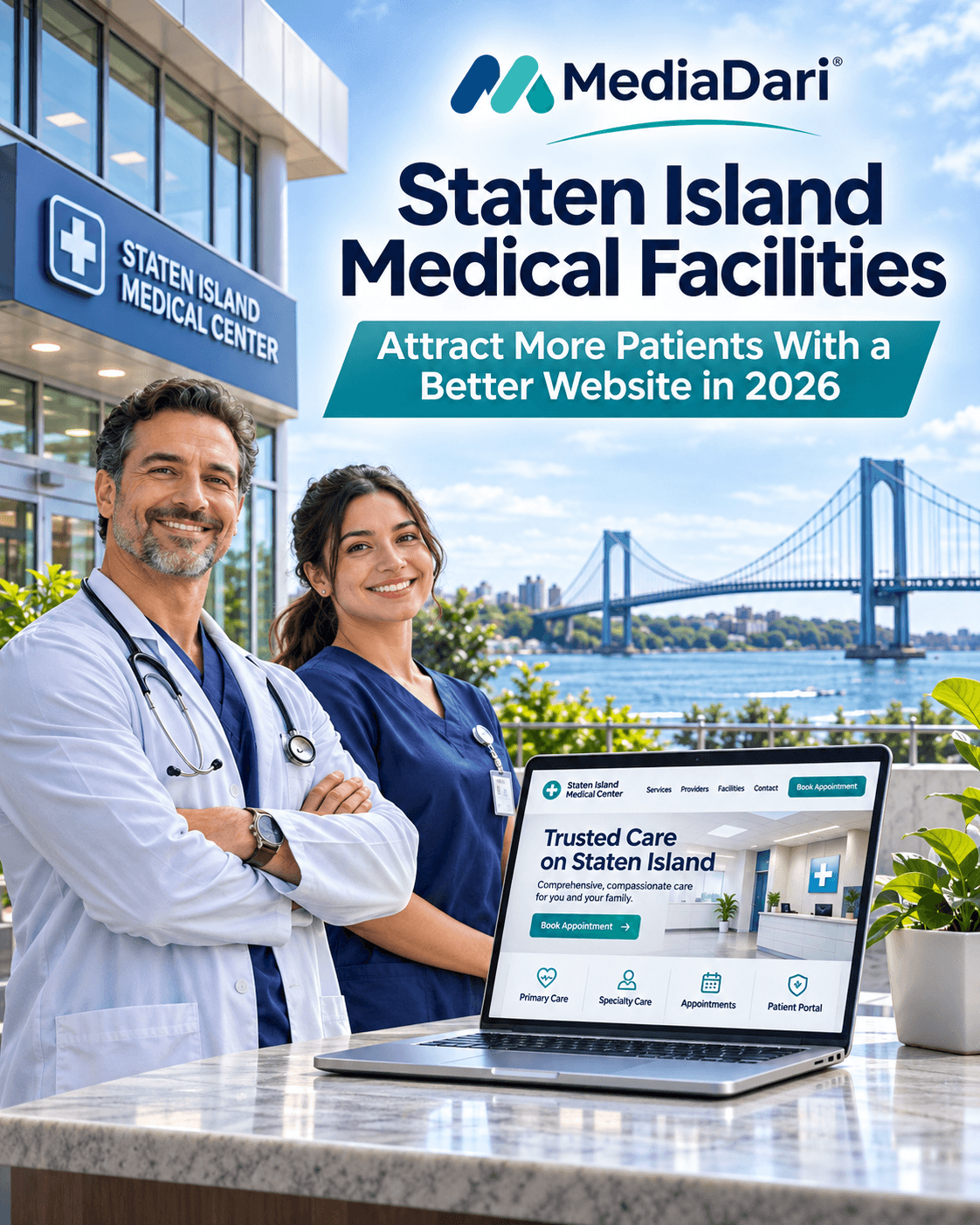
Your medical facility may provide exceptional care, employ experienced professionals, and have a dedicated team. But if potential patients struggle to find your practice online, understand your services, or schedule an appointment, your digital presence could be limiting your growth.
Think about how people search for healthcare today.
A parent in Great Kills needs a pediatrician.
A Staten Island resident in New Dorp is searching for a psychiatric nurse practitioner.
A family in Tottenville is looking for a nearby medical clinic.
Someone in St. George needs to find an urgent care facility.
In each situation, the patient or family member may turn to Google to explore their options.
They search, compare facilities, review credentials, check accepted insurance plans, and look for convenient appointment options.
The question is simple: When potential patients search for the services your medical facility provides, can they find you — and does your website make them confident enough to take the next step?
For Staten Island healthcare organizations, a professional digital presence is no longer just about having a website.
It's about accessibility, credibility, patient communication, and making healthcare services easier to discover.
Let's explore how medical facilities can improve their websites, strengthen local search visibility, and create a better experience for prospective patients.
1. Your Medical Website Is Often the First Patient Experience
Before someone enters your waiting room, speaks with your receptionist, or meets a provider, they may have already formed an impression of your facility.
That impression often begins online.
Imagine comparing two Staten Island medical practices offering similar services.
Medical Facility A
Its website has an outdated layout, unclear service descriptions, limited provider information, and a contact form that's difficult to use on a mobile phone.
Medical Facility B
Its website provides clear information about medical services, professional provider profiles, office hours, accepted insurance plans, and an easy-to-find appointment button.
Which facility would make you feel more confident about scheduling a visit?
A professional website doesn't replace quality medical care.
However, it can remove uncertainty and help prospective patients understand what to expect before contacting your office.
Essential Features of a Medical Practice Website
A well-designed medical website should make it easy to find:
- Medical specialties and available services
- Provider names and professional credentials
- Office locations and contact information
- Accurate operating hours
- Accepted insurance information
- New-patient instructions
- Online appointment options
- Patient portal access, when available
- Accessibility and language assistance information
- Clear directions for urgent or emergency situations
At MediaDari, we develop custom websites for Staten Island businesses, including digital experiences designed around clear communication, intuitive navigation, and meaningful calls to action.
For healthcare organizations, those principles become especially important because visitors may be seeking help with sensitive or time-sensitive concerns.
2. Local SEO Helps Staten Island Patients Discover Your Facility
Search engine optimization, commonly called SEO, helps search engines understand your website and makes your content more discoverable for relevant searches.
For medical practices, location is particularly important.
Consider these example searches:
- Primary care doctor Staten Island
- Psychiatric nurse practitioner Staten Island
- Medical clinic near me
- Urgent care Staten Island
- Physical therapy Staten Island
- Diagnostic testing Staten Island
- Pediatrician Staten Island NY
- Medical practice accepting new patients Staten Island
These are examples of relevant local searches, not verified monthly search-volume figures.
Each search represents a person looking for a specific type of healthcare service.
How Can Medical Facilities Improve Local SEO?
Start by making sure your website clearly explains your medical services and the communities you serve.
Important steps include:
Use accurate location information.
Display your facility's real address, telephone number, and relevant office details.
Create useful service pages.
Describe each major service in clear language that prospective patients can understand.
Maintain consistent business information.
Make sure your website and legitimate online listings display accurate details.
Publish helpful patient-focused content.
Answer common questions about appointments, treatments, preparation, insurance, and your services.
Improve mobile usability.
Patients should be able to find important information without struggling with complicated menus or tiny text.
Local SEO cannot guarantee top Google rankings, but it can help establish a stronger digital foundation for your medical facility.
3. Google Maps Can Be an Important Patient Discovery Channel
Patients frequently use Google Maps to locate healthcare providers, compare nearby options, find directions, and call medical offices.
An accurate Google Business Profile helps eligible medical facilities present important information through Google Search and Maps.
What Should a Medical Facility Include?
- Official facility name
- Correct medical practice category
- Accurate physical address
- Current business hours
- Main contact telephone number
- Website address
- Available appointment link, where supported
- Genuine photographs of the facility
- Relevant services and business details
For healthcare organizations with multiple practitioners or departments, Google has specific rules governing which profiles are eligible.
Creating duplicate listings for every service or specialty is not a valid shortcut to better visibility.
Help Patients Recognize Your Facility
Authentic photographs of your building entrance, waiting area, reception area, and other appropriate spaces can help patients recognize the location.
Make sure photographs respect patient privacy and any applicable consent requirements.
For larger facilities, helpful information about entrances, parking, accessibility, and office locations can also improve the patient experience.
Being discoverable is important. Helping patients arrive prepared and confident is just as valuable.
4. Make Scheduling an Appointment as Simple as Possible
Imagine someone discovers your medical facility at 10:30 p.m.
Your office is closed.
They're interested in booking an appointment but cannot reach your receptionist.
Without a convenient scheduling option, they may postpone contacting your practice or continue comparing providers.
This is where thoughtfully designed digital systems can make a difference.
Give Patients Clear Appointment Options
Depending on your facility's workflow, useful features might include:
- An online appointment scheduling tool
- Clearly displayed office phone numbers
- New-patient appointment instructions
- A secure patient portal
- Information about telehealth availability
- Instructions for existing patients
- Appointment request confirmations
Different Patients May Need Different Scheduling Paths
A new patient requesting an initial psychiatric evaluation may need a different booking process from an established patient scheduling a follow-up visit.
Likewise, a diagnostic center may need to explain whether a referral or provider order is required.
Your website should reflect the actual workflow of your medical facility rather than treating every appointment as identical.
Healthcare Privacy Must Be Built Into the Process
Medical appointment forms can collect sensitive information.
Practices subject to HIPAA should carefully evaluate the scheduling tools, integrations, vendors, access controls, and handling of protected health information.
Where required, appropriate business associate agreements and safeguards must be in place.
A basic contact form or a standard marketing plugin should not automatically be considered suitable for collecting medical information.
The objective is convenience without sacrificing patient privacy or security.
5. Provider Profiles Can Help Establish Patient Confidence
Healthcare decisions are personal.
Before scheduling an appointment, patients may want to understand who will be providing their care.
A medical facility with several physicians, nurse practitioners, therapists, or other professionals should consider creating clear provider profiles.
What Makes a Strong Provider Profile?
An effective profile may include:
- Provider's full professional name
- Verified degrees and credentials
- Medical specialties
- Relevant professional experience
- Conditions or patient populations served
- Languages spoken
- Professional photograph
- Appointment availability information, where appropriate
Avoid vague claims such as "the best doctor on Staten Island" unless such a claim is accurate, substantiated, and permitted under applicable advertising standards.
Instead, communicate genuine experience, professional qualifications, and the services your providers offer.
Use Language That Patients Understand
Medical professionals naturally use clinical terminology.
Patients may not always understand those terms.
For example, a psychiatric practice might explain what a psychiatric evaluation involves rather than simply listing the service name.
A physical therapy practice might describe the types of rehabilitation services available and what new patients can expect at their first visit.
Clear explanations can make a medical facility feel more approachable without compromising professionalism.
6. Medical Facilities Need Dedicated Pages for Important Services
One mistake medical practices make is placing nearly every service on a single page.
Consider a multidisciplinary healthcare facility offering primary care, behavioral health services, chronic condition management, and preventive healthcare.
If every service appears only as a brief bullet point, visitors may not find enough information to understand what is available.
Create Dedicated Service Pages
Depending on the facility, these could include:
Primary Care Services
Explain the types of appointments offered, preventive care services, and relevant patient eligibility requirements.
Behavioral Health Services
Describe available evaluations, therapy, medication management, and other services actually offered by the practice.
Diagnostic Services
Explain available tests, scheduling requirements, referrals, and preparation instructions where appropriate.
Physical Therapy Services
Describe rehabilitation services, treatment approaches, and what patients can expect.
Specialty Care
Provide information about the practice's genuine specialties, consultation processes, and referral requirements.
Why This Helps
Dedicated pages can improve navigation and make important information easier to discover.
They can also provide search engines with clearer context about individual services.
Each page should contain original, medically accurate information reviewed by an appropriately qualified professional.
Avoid copying generic medical descriptions or publishing unverified treatment claims merely to increase keyword coverage.
7. HIPAA Awareness, Security, and Accessibility Matter
Healthcare websites operate in a more sensitive environment than many ordinary commercial websites.
A medical facility must consider the type of information its website collects and how that information is processed.
HIPAA and Website Technology
HIPAA requirements depend on the organization, the data involved, and how technology is used.
For covered entities and business associates, patient portals, scheduling integrations, online forms, and analytics technologies may create privacy and security obligations.
The U.S. Department of Health and Human Services provides guidance on HIPAA and online tracking technologies.
Website administrators should evaluate vendors and information flows carefully, including any third-party advertising or analytics integrations.
Using HTTPS alone does not make an entire website or workflow HIPAA-compliant.
Medical Website Accessibility
Accessibility is another important consideration.
Patients may have visual, hearing, motor, or cognitive disabilities that affect how they navigate websites.
A more accessible design should consider:
- Legible text and sufficient contrast
- Keyboard navigation
- Descriptive form labels
- Appropriate image descriptions
- Captions for relevant video content
- Logical headings
- Compatibility with assistive technologies
- Clear instructions and error messages
The U.S. Department of Justice's web accessibility guidance explains why website accessibility matters for public-facing businesses, including hospitals and medical offices.
A medical website should be designed with accessibility in mind and evaluated against applicable legal and technical requirements.
8. Educational Healthcare Content Can Support Patient Trust and SEO
Many patients search for information before deciding whether to contact a healthcare professional.
A well-maintained healthcare blog can provide educational content, answer common questions, and explain available services.
But medical content requires extra care.
Useful Article Ideas for Staten Island Medical Practices
For a Primary Care Facility
"What to Expect During Your First Primary Care Appointment in Staten Island"
For a Psychiatric Practice
"How to Prepare for Your First Psychiatric Evaluation"
For a Physical Therapy Clinic
"What Happens During an Initial Physical Therapy Assessment?"
For a Diagnostic Center
"How to Prepare for a Scheduled Diagnostic Imaging Appointment"
For a Pediatric Practice
"Questions to Ask When Choosing a Pediatrician in Staten Island"
These topics can help prospective patients understand services and prepare for appointments.
Accuracy Should Come Before Keyword Optimization
Healthcare content should not exaggerate treatment effectiveness, make unsupported medical claims, or replace individualized professional advice.
A sound editorial process should include qualified clinical review, appropriate references, and updates when information changes.
Provider expertise and clearly identified authorship can also help readers understand the source of the information.
For medical facilities, quality content isn't simply a marketing asset. It's part of responsible patient communication.
9. Connect Your Website With Your Broader Digital Marketing Strategy
A medical facility may maintain a website, Google Business Profile, Facebook page, Instagram account, and various healthcare directory listings.
However, those channels may not communicate a consistent message.
A coordinated strategy connects them around accurate information and appropriate patient actions.
A Possible Patient Discovery Journey
Step 1: Google Search
A potential patient searches for a healthcare service available in Staten Island.
Step 2: Website Visit
The patient discovers your facility and reviews available services.
Step 3: Provider Information
They read verified professional profiles and learn about the care offered.
Step 4: Appointment Instructions
They find the appropriate scheduling option and review insurance or referral requirements.
Step 5: Secure Scheduling
The patient completes an appropriate appointment process.
This is an example of a patient journey, not a guaranteed outcome.
The objective is to make the process understandable and accessible at each stage.
Use Social Media Responsibly
Healthcare organizations can use social media to share general educational information, introduce their staff with permission, communicate service updates, and explain their approach to care.
However, patient privacy, professional advertising standards, platform policies, and applicable regulations should guide every campaign.
Sensitive patient information should never be used casually for marketing or audience targeting.
10. Measure Meaningful Patient Inquiries, Not Just Website Visits
An attractive website that receives thousands of visits may still fail to support a practice's operational goals if patients struggle to contact the facility.
This is why website performance should be evaluated beyond page views.
Metrics Worth Monitoring
Medical facility administrators may benefit from tracking:
- Search visibility for relevant services
- Website visits to individual service pages
- Appointment scheduling completion rates
- General administrative contact inquiries
- New-patient appointment availability
- Website accessibility and performance issues
- Mobile usability problems
- Where prospective patients abandon scheduling workflows
Protect Privacy When Measuring Results
Analytics and advertising tools must be configured appropriately for the facility's privacy obligations.
Avoid transmitting patient identities, diagnoses, appointment reasons, or other sensitive information to analytics vendors without a lawful basis and necessary safeguards.
Where appropriate, use aggregated or otherwise privacy-protective operational reporting.
Focus on Better Patient Access
For healthcare organizations, success should not be measured solely by marketing volume.
A better digital experience can also mean patients finding accurate hours, understanding referral requirements, locating the correct facility, and accessing scheduling information without unnecessary confusion.
That is a meaningful improvement even before considering business growth.
11. When Should a Staten Island Medical Facility Redesign Its Website?
Not every healthcare website requires a complete rebuild.
Some practices may only need clearer service descriptions, updated provider profiles, or improvements to their scheduling process.
Others may have deeper design, accessibility, performance, or technical limitations.
Signs Your Medical Website May Need Attention
- The design is outdated or difficult to navigate.
- Appointment buttons are hard to locate.
- Important services lack dedicated pages.
- The website performs poorly on mobile devices.
- Provider details or insurance information are outdated.
- Patients frequently call to ask questions that the website should answer.
- The scheduling process creates unnecessary friction.
- Accessibility issues have not been evaluated.
- Privacy and security safeguards need review.
- Your practice has expanded, but your website still reflects its old services.
A redesign should begin with understanding the facility's actual needs.
The right solution might involve website development, content improvement, scheduling integration, privacy assessment, or a combination of these elements.
Frequently Asked Questions About Staten Island Medical Website Design
Do medical facilities need professional website design?
A professional website can help healthcare organizations explain their services, present verified provider information, communicate office details, and make appropriate appointment processes easier to access.
The specific requirements depend on the facility's size, specialties, and patient population.
Can SEO help a medical practice attract more patients?
SEO can improve opportunities for prospective patients to discover relevant services through search engines.
Results depend on competition, content quality, technical implementation, location, and other factors. No specific ranking or appointment volume can be guaranteed.
Is a custom medical website better than a basic website builder?
Both approaches can support certain medical practice websites.
Custom development may provide additional flexibility for specialized workflows, branding, performance optimization, and integrations.
However, compliance depends on the complete system and its operation, not simply whether a website is custom-built or created with a website builder.
Does a medical website need to be HIPAA-compliant?
Medical organizations subject to HIPAA must comply with applicable requirements when their websites and connected systems handle protected health information.
A public informational page and a patient portal may present different obligations. The organization should evaluate the particular data flows, vendors, safeguards, and applicable requirements.
What should medical facilities prioritize first?
Start with accurate service information, usable mobile navigation, current provider details, clear appointment pathways, accessibility, and appropriate privacy protections.
After establishing that foundation, evaluate SEO and other marketing opportunities.
Final Thoughts: Your Medical Facility's Digital Experience Should Reflect Its Quality of Care
Staten Island healthcare organizations serve patients with different needs, concerns, and expectations.
Some patients are looking for routine preventive care.
Others are seeking specialty services, evaluations, or ongoing treatment.
Regardless of the service, prospective patients benefit from accurate information, clear communication, and convenient access to the appropriate next step.
Your website has an important role in that process.
A thoughtfully designed healthcare website can help communicate professional credibility, explain available services, support patient navigation, and improve online discoverability.
Your medical facility may provide outstanding care. Your digital presence should make it easier for the people you serve to understand and access that care.
Is Your Staten Island Medical Facility Ready for a Better Website?
At MediaDari, we help local businesses and professional practices strengthen their digital presence through custom website design, development, search optimization, and ongoing digital content strategies.
We understand that healthcare organizations have unique needs involving professionalism, patient communication, specialized services, and privacy considerations.
Whether you're establishing a new private practice, updating an existing clinic website, or exploring ways to improve patient access online, a more intentional digital strategy can provide a stronger foundation.
Our approach begins with understanding your organization, its services, and the people it aims to serve.
Explore a Better Digital Experience for Your Practice
Discover MediaDari's Staten Island Website Design Services
Learn how a custom digital presence can help your organization communicate its value and make its services easier to discover.
MediaDari — Custom Web Development, SEO, Digital Marketing & AI Automation for Local Businesses and Professional Practices.
Ready to strengthen your online presence?
MediaDari helps businesses with web design, development, digital marketing, branding, and AI automation.
Let's Talk