MediaDari Insights/General Marketing
Staten Island Restaurant Marketing: 10 Ways to Get More Customers, Orders & Reservations in 2026
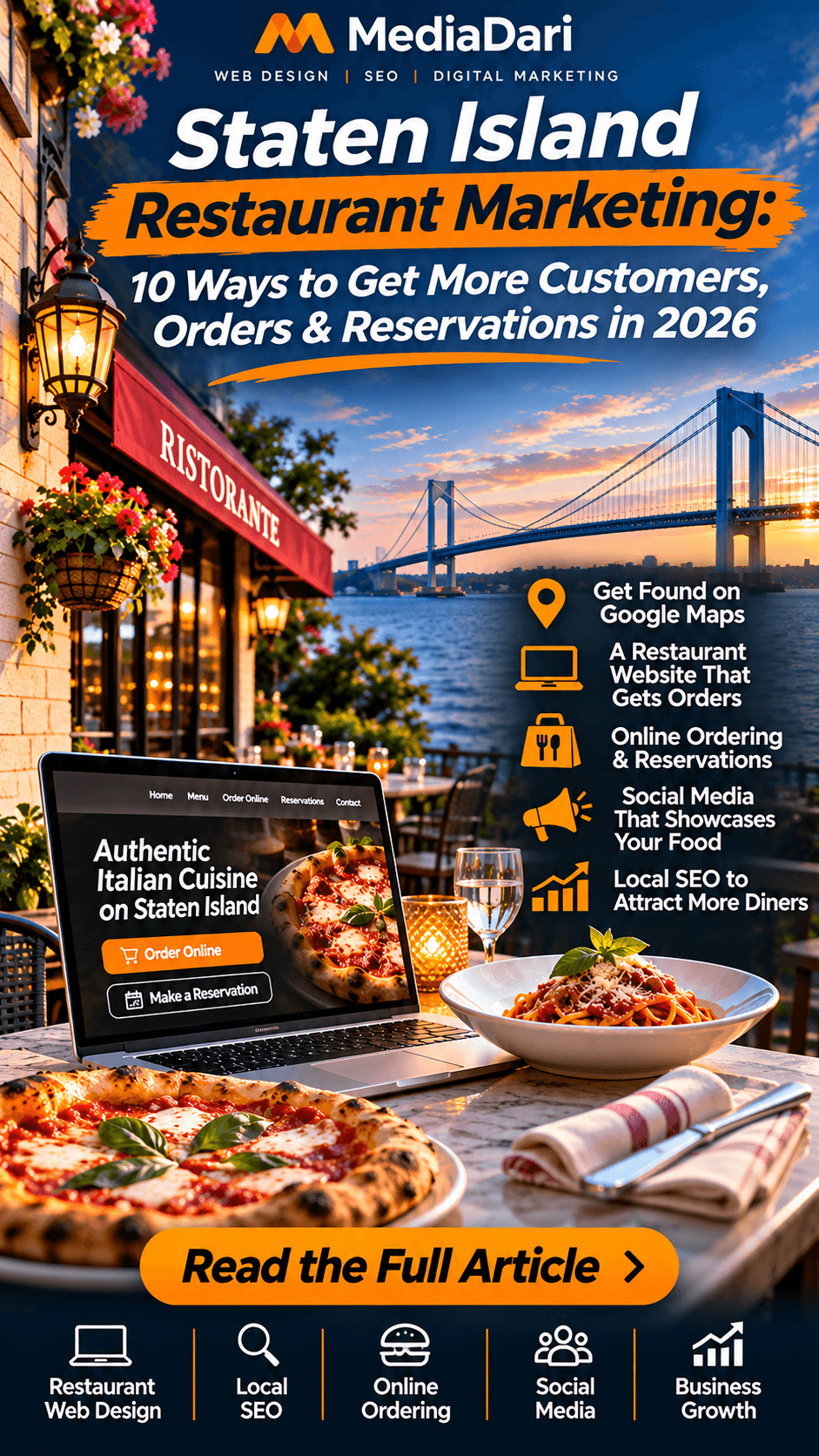
You could serve the best pizza on Staten Island, make an incredible plate of pasta, or have the most welcoming café in your neighborhood. But if customers can't find your restaurant online, how will they know what they're missing?
Staten Island has a rich dining culture.
From neighborhood pizzerias and Italian restaurants to bakeries, diners, coffee shops, and family-owned establishments, the borough offers plenty of places for residents to enjoy a meal.
But running a restaurant is about more than serving great food.
Restaurant owners must manage employees, food costs, inventory, customer service, and everyday operations.
And somewhere between all those responsibilities, they're expected to market their businesses.
Meanwhile, potential customers are searching Google for places to eat.
A family in Tottenville might search for a nearby Italian restaurant.
Someone in Great Kills could be looking for pizza delivery.
A couple in St. George might be comparing restaurants for date night.
A resident in New Dorp may be looking for a café that serves breakfast.
The question isn't just whether your food is good. It's whether customers can discover your restaurant, trust what they see, and easily place an order or make a reservation.
Here are ten restaurant marketing strategies that can help Staten Island establishments build their online presence and create more opportunities for customer growth.
1. Make Your Restaurant Easy to Find on Google Maps
Imagine someone searches Google for "pizza near me" while traveling through Staten Island.
Google may display nearby restaurants with business information, reviews, hours, photographs, and directions.
This makes your Google Business Profile an important part of your restaurant's online presence.
What Should Your Restaurant's Google Profile Include?
Make sure customers can easily find:
- Your restaurant's correct name
- Accurate address and phone number
- Current operating hours
- Restaurant category and cuisine information
- A link to your website
- An accurate menu
- Authentic photographs of your food
- Available online ordering options
- Reservation information, where applicable
Google's local search results are influenced primarily by relevance, distance, and prominence.
You cannot control how close every potential customer is to your restaurant.
But you can control the accuracy of your business information and how clearly your restaurant is represented online.
Don't Ignore Your Restaurant Photographs
People want to see what they're ordering.
Professional photographs of your signature dishes, dining area, and restaurant atmosphere can help customers understand what to expect.
Instead of uploading random stock photographs, showcase the actual meals your kitchen prepares.
A beautifully photographed plate of pasta, fresh pizza, or signature dessert can make your restaurant more appealing to someone comparing options.
Your food should be one of your strongest marketing assets.
2. Stop Treating Your Website Like an Online Business Card
Some restaurant websites contain little more than a logo, address, phone number, and an outdated menu.
That might provide basic information, but it misses opportunities to serve customers.
A well-designed restaurant website should make it easy for visitors to explore your food, understand your atmosphere, and take action.
Your Restaurant Website Should Answer These Questions
- What kind of food do you serve?
- Where are you located?
- What are your hours?
- Can customers dine in?
- Do you offer takeout or delivery?
- Can customers place orders online?
- Can they make reservations?
- Is your menu easy to read?
- What makes your restaurant worth visiting?
What Makes a Restaurant Website Effective?
Imagine visiting two websites.
The first is slow, difficult to navigate, and forces you to download an outdated menu.
The second loads quickly, displays appetizing food photographs, provides an easy-to-read menu, and prominently features an Order Online button.
Which would make ordering dinner easier?
That's why restaurant website design should prioritize convenience and usability.
At MediaDari, we build custom websites for Staten Island businesses, with a focus on responsive design, intuitive navigation, and clear customer actions.
For a restaurant, those actions might include online ordering, reservations, directions, and phone calls.
Your website should make ordering food easier, not more complicated.
3. Give Customers a Better Online Ordering Experience
Online ordering can be an important source of business for restaurants offering takeout and delivery.
But not every ordering experience is equally convenient.
Some restaurant websites send customers through several different pages before they can view a menu or complete an order.
Others rely exclusively on third-party ordering platforms.
Consider Offering Direct Online Ordering
Depending on your restaurant's operational needs, a direct ordering system can offer benefits such as:
- A branded customer experience
- More control over how menu items are presented
- Customizable pickup or delivery options
- Greater flexibility with promotions
- Access to permitted customer order information
- Potentially different transaction costs compared with third-party marketplaces
That doesn't mean third-party delivery platforms are always a bad choice.
They can provide additional customer exposure and useful ordering infrastructure.
The right strategy depends on transaction fees, staffing, delivery logistics, customer demand, and your restaurant's capacity.
Make Ordering Simple
Your online ordering process should let customers:
- Browse the menu.
- View accurate prices and descriptions.
- Select available modifications.
- Choose pickup or delivery, where offered.
- Review their order and fees.
- Complete checkout securely.
- Receive confirmation and relevant updates.
A confusing ordering process can create unnecessary friction at the moment a customer is ready to purchase.
4. Use Instagram and TikTok to Make People Crave Your Food
Restaurant owners have a natural advantage when it comes to creating social media content.
Food is visual.
A fresh pizza coming out of the oven, a chef preparing a signature dish, or a dessert being plated can become engaging short-form video content.
And you don't need an expensive commercial production every time.
Content Ideas for Staten Island Restaurants
The Kitchen Experience
Film a short video showing how a popular dish is prepared.
Before and After
Show pizza dough being transformed into a finished pie.
Meet the Chef
Introduce the people who bring your menu to life.
Signature Dish Spotlight
Feature a popular menu item with clear pricing and availability.
Behind the Scenes
Show staff preparing the dining room before opening.
The Restaurant Story
Explain why the owner opened the restaurant and what makes it meaningful to the neighborhood.
Make Your Content Local
Instead of relying only on broad hashtags, use location-specific descriptions and relevant local tags.
For example:
#StatenIslandFood #StatenIslandEats #StatenIslandRestaurants #StatenIslandNY #StatenIslandPizza
Authentic content that shows real food and real people can help make your restaurant memorable.
You don't need to become an influencer. You need to make your restaurant worth remembering.
5. Create Local SEO Content That Matches What Diners Search For
Search engine optimization can help restaurants improve their organic visibility for relevant searches.
But restaurant SEO involves more than repeating "best restaurant Staten Island" throughout your website.
Google needs to understand your restaurant's actual cuisine, location, menu, and services.
Think About Specific Customer Searches
Examples might include:
- Italian restaurant Staten Island
- Staten Island pizza delivery
- Breakfast café Staten Island
- Family restaurant Staten Island
- Staten Island restaurant with outdoor seating
- Catering services Staten Island
- Restaurant near St. George ferry terminal
These are keyword examples rather than verified search-volume rankings.
A restaurant in Great Kills offering catering might benefit from a dedicated catering page that explains available packages, event sizes, and inquiry procedures.
A café in St. George could benefit from making its actual location and breakfast offerings clear.
Create Useful Pages Instead of Keyword-Stuffed Pages
Depending on your restaurant, useful website pages might include:
Our Menu
An accessible, current menu with accurate item names, prices, and descriptions.
Catering Services
Details about catering options, minimum orders, and how to request information.
Private Events
Information about available event spaces, capacity, and reservation procedures.
Our Story
The restaurant's history, owners, and connection to the community.
Contact & Directions
Hours, location, parking information, and ways to get in touch.
The goal is to make your website useful to customers while giving search engines accurate information about your establishment.
6. Make Your Online Menu Easy to Access and Update
A restaurant's menu is one of the most important pieces of information on its website.
Yet menus are often difficult to use.
Some establishments publish a blurry photograph of a printed menu.
Others upload a large PDF that requires customers to zoom repeatedly on their phones.
Build a Mobile-Friendly Menu
An effective restaurant menu should feature:
- Clear food categories
- Accurate item descriptions
- Current prices
- Readable typography
- Relevant food photographs
- Clearly identified available options
- Useful allergen information when provided
- Easy access from the homepage
Why Menu Accuracy Matters
Imagine someone discovers your restaurant online because they're looking for a particular dish.
They arrive and discover that the menu hasn't been updated in months.
That can create frustration before the customer even places an order.
Restaurant owners should establish a simple process for updating menus, pricing, and availability.
A content management system can make routine updates easier without requiring a developer for every small change.
A modern restaurant website should evolve as your menu and business evolve.
7. Turn Happy Customers Into Repeat Customers
Attracting a first-time customer is important.
Giving that customer a reason to return is equally valuable.
Consider a family that orders from your Staten Island pizzeria every Friday.
They're already familiar with your food and service.
With an appropriate loyalty program or permission-based marketing strategy, your restaurant may be able to strengthen that existing relationship.
Ways to Encourage Repeat Business
- Digital loyalty programs
- Birthday offers
- Seasonal menu announcements
- Special event invitations
- New menu item promotions
- Optional email or text updates
- Customer appreciation campaigns
Example: Build a Simple Customer Loyalty Program
A coffee shop might offer a reward after a set number of eligible purchases.
A restaurant could share a seasonal promotion with customers who have opted in to receive marketing messages.
A bakery might announce holiday preorder availability through its email list.
Any email or SMS marketing program should follow applicable consent, opt-out, and consumer protection requirements.
The objective is to build genuine relationships, not bombard customers with advertising.
8. Use Google Reviews to Strengthen Your Restaurant's Reputation
Online reviews can influence how potential customers evaluate unfamiliar restaurants.
Someone choosing between two Italian restaurants may compare recent customer experiences before making a reservation.
A thoughtful review strategy can help your business maintain an active and authentic online reputation.
Encourage Genuine Reviews
You can invite customers to leave honest feedback by:
- Sharing a Google review link after an appropriate interaction
- Displaying a review QR code at the establishment
- Including a polite review invitation on an eligible receipt
- Asking satisfied customers to share their experiences
Never buy fake reviews, offer rewards in exchange for Google reviews, or pressure customers to post only positive feedback.
Respond Professionally
When customers leave positive feedback, a short, appreciative response can be appropriate.
When someone raises a concern, respond respectfully and offer a suitable channel to resolve it.
Avoid arguing publicly with customers.
A professional response can demonstrate that your business takes feedback seriously.
Your reputation isn't just what you say about your restaurant. It's also what customers experience and share.
9. Consider Local Advertising That Brings Customers Closer to Ordering
Restaurant advertising can take several forms.
Google Search campaigns may help reach people actively looking for particular dining options.
Facebook and Instagram advertisements can introduce your restaurant to local audiences using engaging photographs and videos.
However, paid advertising should always be evaluated against the actual economics of your restaurant.
Example: A Staten Island Pizzeria Campaign
Imagine a pizzeria wants to promote a new family dinner special.
Its campaign could include:
Advertisement: A short video showing the meal being prepared.
Audience: An appropriate local geographic audience based on the restaurant's delivery or pickup area.
Call to Action: View Menu or Order Online.
Destination: A dedicated landing page or ordering page featuring the actual offer.
Tracking: Campaign-attributed orders, total sales, and advertising costs.
This creates a clearer connection between the advertising message and the customer's next action.
Track Profitability, Not Just Clicks
Suppose a restaurant spends $300 on advertising and receives $1,200 in attributed orders.
That represents a 4:1 return on ad spend in gross sales terms.
However, the restaurant must still account for food, labor, packaging, payment processing, and other expenses.
Revenue alone does not establish whether the campaign was profitable.
A successful restaurant marketing strategy should consider what the business actually earns, not just how many people saw an advertisement.
10. Stop Managing Every Marketing Channel Separately
Many restaurant owners maintain an Instagram page, Facebook page, Google Business Profile, website, and online ordering system.
But these channels may be managed inconsistently.
The website might display one set of hours while Google displays another.
The online menu may have different prices.
Social media may promote a special that has already ended.
This can create confusion for customers and unnecessary work for staff.
Build a Connected Digital Marketing System
A coordinated approach might include:
Website Management
Maintain current menus, hours, service information, and promotions.
Google Business Profile Management
Keep important business details and relevant links updated.
Social Media Content Creation
Prepare regular photographs, videos, announcements, and promotional content.
Local SEO
Improve relevant website content and address technical issues.
Advertising Management
Develop, monitor, and adjust paid campaigns based on business objectives.
Customer Communications
Provide permission-based updates and useful customer information.
Reporting
Review orders, reservations, inquiries, marketing expenses, and business outcomes.
A coordinated system can reduce duplicated effort and make a restaurant's digital presence more consistent.
At MediaDari, our focus is on helping local businesses develop clearer, more effective digital experiences through website design, development, search optimization, and related marketing strategies.
How Much Business Could Better Restaurant Marketing Generate?
Let's look at a hypothetical scenario.
Imagine a Staten Island restaurant improves its online ordering experience and launches a local marketing campaign.
During the following month, the restaurant receives 60 additional orders attributed to those efforts.
If the average order value is $35:
60 additional orders × $35 = $2,100 in additional gross sales.
Now suppose some of those customers return regularly.
The long-term value of those relationships could be greater than the value of the initial orders.
However, this is an illustrative example, not a projection or guarantee.
Actual results depend on demand, order frequency, competition, margins, advertising costs, execution, and customer satisfaction.
The important lesson is that even modest improvements can be worth evaluating when you measure their real effect on the business.
Frequently Asked Questions About Staten Island Restaurant Marketing
How can a Staten Island restaurant get more customers?
Restaurants can improve their customer acquisition opportunities through accurate Google Business Profiles, professional websites, local SEO, social media content, genuine reviews, online ordering, and targeted advertising.
A consistent customer experience remains essential.
Does my restaurant need a website if I already use Instagram?
Instagram can help people discover your food and restaurant.
A dedicated website gives your business a central place to present menus, ordering options, hours, contact information, and reservation details.
Both platforms can complement each other.
Can SEO help a local pizzeria get more orders?
SEO may help a pizzeria become more discoverable for relevant local searches.
That can create opportunities for additional website visits and orders, although results depend on competition, location, customer demand, and other factors.
Is Google Maps important for Staten Island restaurants?
Yes. Google Maps can help customers discover local restaurants, see operating hours, browse information, get directions, and access supported ordering or reservation links.
An accurate business profile is a valuable foundation for local visibility.
What should a restaurant prioritize first?
Start with the fundamentals: correct hours, an accessible menu, genuine food photography, accurate Google information, a usable mobile website, and an easy ordering or reservation process.
Then consider additional content, advertising, and loyalty initiatives based on your business goals.
Final Thoughts: Great Food Deserves Great Marketing
Staten Island restaurant owners work hard.
Early mornings, late nights, busy weekends, inventory management, staffing, and customer service are all part of running a food business.
Your marketing should support those efforts rather than create more unnecessary work.
A professionally designed website, accurate local search presence, engaging social content, and convenient ordering options can help your restaurant compete for attention.
But successful restaurant marketing isn't simply about posting photographs or increasing website traffic.
It's about helping hungry customers discover your restaurant, choose your food, and come back again.
Whether you're operating a neighborhood pizzeria, an independent café, a bakery, or a full-service restaurant, your online presence should reflect the quality of the experience you provide.
Ready to Grow Your Staten Island Restaurant's Online Presence?
At MediaDari, we help local businesses establish stronger digital foundations through custom websites, search optimization, branding, content strategy, and digital marketing.
For restaurants, that can mean building a more appealing website, improving menu accessibility, integrating suitable ordering tools, and creating better pathways for customers to contact or visit the business.
Your Next Customer May Be Deciding Where to Eat Right Now.
Make sure your restaurant is easy to find, easy to understand, and easy to choose.
Explore MediaDari's Staten Island Web Design & Digital Growth Services
Discover how a stronger digital presence can support your restaurant's next stage of growth.
MediaDari — Web Design, SEO, Digital Marketing & AI Automation for Local Businesses.
Ready to strengthen your online presence?
MediaDari helps businesses with web design, development, digital marketing, branding, and AI automation.
Let's Talk